
This cinematic icon delvers both destruction & delight for both newcomers and longterm fans of the Kaiju King.
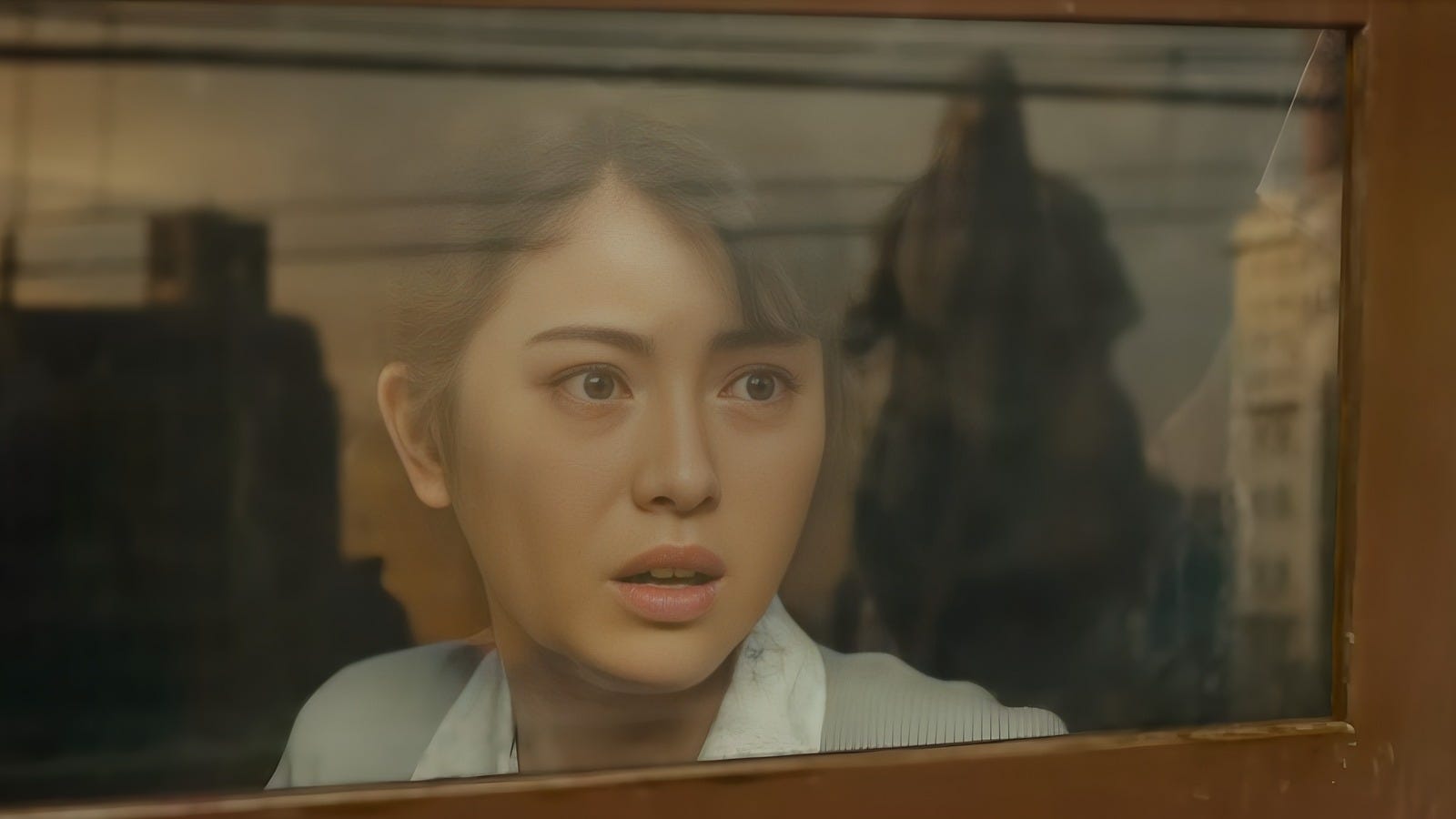
Full disclosure, I never really grew up on any of the Godzilla films or anything relating to this giant lizard. Other than the decent Legendary Studios tetralogy, and the infamous 1998 film, Godzilla has never fully resonated with me as a “must watch” franchise. Then Minus One came out and everyone’s eyes watched with shock & awe as this titan of the film industry stood tall with both financial & critical success that nobody could’ve anticipated, including myself. Godzilla Minus One is a great example of “less is more” when comparing it to recent Godzilla projects, considering that it makes to go the extra mile within every aspect and still shine brighter than a nuclear bomb.
When discussing a Godzilla Movie, the first thing that usually gets thrown to the wayside is the plot, as most movies can be summarized as “Godzilla must be stopped, or stop something else from destroying a city (usually Tokyo)” but this time, we mange to see a personal story told using the hulking menace. Without giving too much away, our protagonist Koichi, is a Kamikaze pilot who’s base is attacked by a pre-nuclear Godzilla. Being unable to save his fellow soldiers from the beast, he feels this invisible weight that prevents him from moving on in life, believing that he’s a body without a soul. Fast forward a couple of years later, he’s found a surrogate family of his own as Japan builds itself up from war-torn destruction, but when Godzilla returns to wreck havoc on the already weakened nation, Koichi is torn between honouring his fallen comrades, or to put the past behind him. It’s a personal story that delves into the flawed ideas of both the Japanese side of World War II, while divulging into the moral ethics of what “honour” really means at the end of the day, and in a Godzilla movie no less.
See, normally the biggest thing that I detest in any Godzilla project is that I pay to see Godzilla and I end up getting either someone suffering though a midlife crisis or a bunch of teenagers fighting an evil corporation, and Godzilla is just chilling in the background. These human segments end up killing the pacing for much of these films, and their plots either make no sense to belong in a Godzilla film or its hastily connected to Godzilla to justify it existing in the script. If you don’t believe me, go back and watch the 2014 Godzilla film, he’s only in the movie for less than 10 minutes and you barely see his full body. However, while Godzilla Minus One is mainly focused on the human characters, they’re all affected by Godzilla either directly or emotionally. Koichi is personally hunted & haunted by Godzilla, both at the opening of the film, to being chased at sea, to even suffering from PTSD of the initial attack. His friends are commissioned to fight the beast before he demolishes Japan, to his love interest having an encounter with Godzilla full on later in the film. The movie clearly portrays a conflict between the humans and Godzilla, thus giving us a film where the humans revolve around Godzilla, and when something happens in the plot, we feel its effects resonate throughout the Tokyo presented to us
Speaking of the beast, Godzilla is back to cracking building as a proper antagonist. Just like the classic films, this big bastard has only one goal, to destroy. Rather in water or on land, these destruction scenes are layered out perfectly to display the best elements of the titular titan, while keeping the destruction unique so it isn’t just “he picks up a bus and he puts it back down” then repeat. Every action scene from beginning to end is jam packed with absolute carnage, and the thing that surprised me the most is that this movie not only had a $15 million dollar budget, but the director Takashi Yamazaki, not only wrote, directed, and created the special effects for the film. On a $15 million dollar budget, the film is visually sound, giving us plenty of iconic shots and compositions that help add more to the story & characters. The music composed by Naoki Sato combines elements of classic Godzilla scores while keeping each track unique enough to compliment the action on screen, almost like pairing a selection of cheese with a fine wine. And all this is done on only $15 million. To put this into retrospective, cinematic trash like The Marvels & Indiana Jones 5 had almost 10x the budget as Godzilla Minus One, yet I feel that the visuals, storytelling, and overall experience was more impactful here than against any of the big budget crap pushed out over the fast few years.
Honestly, if I had to share some negatives, I feel that the pacing in the beginning after Koichi returns from the war was a bit too long. You could argue that it needed the time to let Koichi settle into post war Tokyo, yet if it went longer, it could have a case where the film disengages from the audience, especially since the film’s namesake doesn’t show up for another half an hour. Also as much as I liked the film, the last shot felt like an afterthought for the sake of either teasing a sequel or connecting the film to other Godzilla movies that I haven’t seen. It just left a sour taste in my mouth, like it was all for naught.
Overall, Godzilla Minus One is the much needed antidote for the poison that the franchise found itself in during the 2010’s and well into the 2020’s. Doing the impossible, it actually delivered well written human characters, making them feel as important to Godzilla himself, alongside telling a story of honour, recovery, and family before all. It’s still a Godzilla movie, first & foremost, but it’s one that feels more modern with its storytelling, even though it takes place in the 1940’s. There’s nothing more that I can really say about it, considering that this is a project that’s best viewed blind, and I swiftly encourage you to watch this movie, and support this style of filmmaking.
9/10
(Calling it now, the new Godzilla x Kong film will have Godzilla & Kong in the film for like 15 minutes each.)
 Stargazer